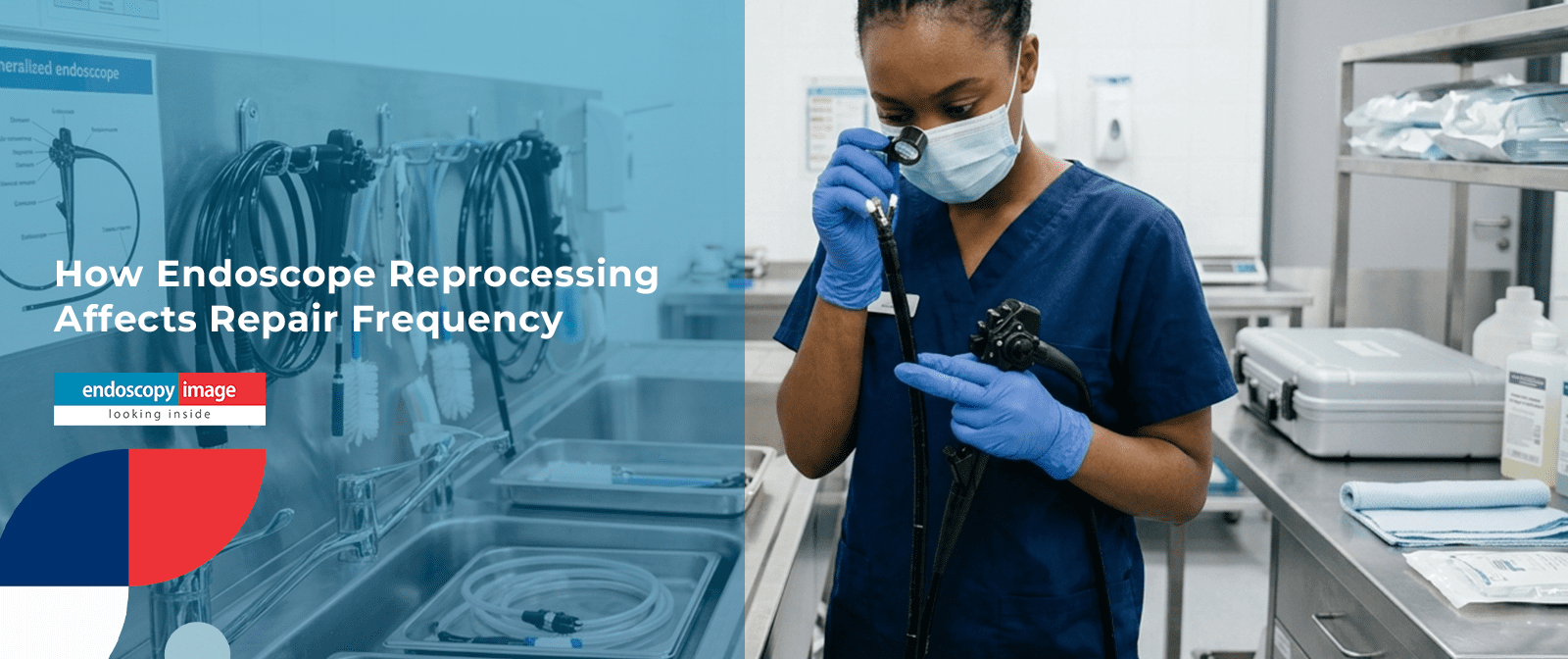
How Endoscope Reprocessing Affects Repair Frequency: What Every GI Manager Should Know | Endoscopy Image
Discover the key differences between endoscopy and colonoscopy procedures. Expert guide for medical..

+1 (786) 681-5247
admin
March 19, 2026
Flexible endoscopes are among the most complex and most expensive reusable devices in clinical medicine. A single video gastroscope can cost upward of $30,000. A colonoscope or duodenoscope, more. And yet these instruments pass through reprocessing cycles — sometimes dozens per week — in workflows that, if not executed precisely, can shorten their functional lifespan significantly and increase repair frequency in ways that are both preventable and costly.
For GI managers, endoscopists, and biomedical engineers, understanding the relationship between endoscope reprocessing and repair frequency is not an academic concern — it is a financial and patient safety imperative. This article examines the documented mechanisms by which reprocessing practices damage flexible endoscopes, the evidence base behind that connection, and what your unit can do to reduce both repair costs and instrument downtime.
The link between reprocessing practices and endoscope repair frequency is well established in the literature, even if many of the specific quantitative relationships are still being studied. What is clear is that the reprocessing process itself — when done incorrectly, incompletely, or with the wrong materials — is a primary driver of mechanical and optical damage in flexible endoscopes.
A peer-reviewed study published in Biomedical Instrumentation & Technology (PMC, 2024) evaluated the impact of routine borescope inspections on endoscope repair costs at a large academic medical center over a three-year period. The findings were striking: total repair costs fell from approximately $1.2 million in 2022 to around $724,000 in 2024 after systematic internal inspection protocols were implemented — suggesting that proactive identification of reprocessing-related damage is itself a significant cost-reduction strategy.
Source: Impact of Borescope Inspections on Endoscope Repair Frequency and Costs. PMC / Biomedical Instrumentation & Technology, 2024.
The same study documented that internal channel defects appeared in GI endoscopes within one to two months of procedural use under standard conditions — underscoring how rapidly damage accumulates when pre-cleaning and inspection steps are not rigorously followed.
Reprocessing-related damage to flexible endoscopes occurs through several distinct mechanisms. Understanding each helps identify where in the workflow the greatest risks lie.
Enzymatic detergents and high-level disinfectants (glutaraldehyde, OPA, peracetic acid) degrade polymer sheaths, O-rings, and adhesive joints over repeated exposure. Using incompatible agents — or concentrations above validated ranges — accelerates this process.
If an endoscope with an undetected micro-perforation is immersed in cleaning or disinfecting solution without prior leak testing, fluid enters the internal cavity. Fluid invasion is one of the most common causes of costly electronic and optical repairs.
Over-coiling during transport, forced angulation when drying, improper hanging posture, and contact with hard surfaces during reprocessing all cause stress fractures in the insertion tube sheath and bending section.
When pre-cleaning is delayed after a procedure, body fluids dry on external and internal surfaces, including the working channel. Current guidelines specifically flag delayed reprocessing as a risk factor for both biofilm formation and endoscopic damage.
Using brushes with incorrect diameter, worn brush tips, or non-validated cleaning tools causes channel wall abrasion. Over time, this damages the smooth surface of internal channels, creating sites for debris retention and micro-crack propagation.
Some automated reprocessors (AERs) use thermal disinfection cycles. Repeated thermal cycling — particularly in older AER models not calibrated to manufacturer specifications — can stress the adhesive and polymer components of the scope.
Standard endoscope reprocessing follows a well-defined sequence. According to STERIS and published multi-society guidelines (ASGE, SGNA, APIC), the validated workflow involves six essential steps. Each step carries its own damage risk profile.
Highest damage risk from delay. If body fluids are allowed to dry before pre-cleaning begins, subsequent cleaning steps become less effective, and dried soil can harden inside channels. Current guidelines from ASGE recommend immediate point-of-use treatment — not after transport to the reprocessing area.
Critical checkpoint. The leak test must occur before any immersion in liquid. Skipping or rushing this step means that an endoscope with an undetected breach is submerged in enzymatic solution or disinfectant — causing fluid invasion that is often irreversible without major repair.
Most critical and most error-prone step. Published data from PubMed (Burdick & Hambrick, 2004) notes that manual cleaning is the most susceptible step to error and that improper cleaning can overwhelm all subsequent disinfection steps. Using the wrong brush size, forcing brushes through angulated sections, or using non-validated detergents are common damage sources.
Underutilized protective step. Post-cleaning visual inspection using a magnifier or borescope allows identification of internal channel damage before it progresses. Evidence from the 2024 academic center study cited above supports incorporating routine borescope inspection as a cost-reduction strategy.
Chemical compatibility is essential. Only validated disinfectants compatible with the specific endoscope model — per the manufacturer’s IFU — should be used. Substituting agents without validation risks polymer degradation and seal failure over repeated cycles.
Residual moisture and mechanical handling matter. Inadequate drying promotes microbial regrowth inside channels. Over-coiling during storage or transport stresses the insertion tube. Guidelines recommend loosely coiling the scope in a transport container that does not compress it.
A common question among GI managers is whether automated endoscope reprocessors (AERs) reduce repair frequency compared to manual reprocessing. The evidence suggests the relationship is more nuanced than a simple automated-is-better conclusion.
A 2024 retrospective study published in PMC analyzed repair records from two academic centers using different reprocessing approaches — one employing automated centralized reprocessing, and one using manual reprocessing performed on-site by a dedicated technician. The center using manual reprocessing with on-site technicians had substantially lower repair rates, which the authors attributed in part to reduced transportation handling and closer technician ownership of each instrument.
Source: Establishing Usage Patterns and Repair Costs for Video Rhinolaryngoscopes. PMC, 2024. Note: this study evaluated rhinolaryngoscopes, not GI endoscopes — findings are directionally relevant but not directly transferable.
| Factor | Manual Reprocessing | Automated Reprocessor (AER) |
|---|---|---|
| Cleaning consistency | Variable — operator-dependent | Standardized cycle |
| Handling damage risk | Lower if on-site, dedicated technician | Higher if transport required |
| Chemical exposure control | Risk of incorrect concentration | Pre-calibrated dosing |
| Error documentation | Dependent on manual logging | Automated cycle logging |
| IFU compliance | Training-dependent | Validated per scope model |
The takeaway is not that one method is categorically superior — it is that the quality of execution matters more than the method itself. A well-trained, accountable technician performing manual reprocessing with validated tools can maintain instrument integrity effectively. An AER used without proper maintenance or with the wrong scope adapter introduces its own failure modes.
Current multi-society guidelines are explicit: endoscopes should be reprocessed immediately after use. Delayed reprocessing — defined as allowing the scope to sit soiled for an extended period before any cleaning begins — is documented to increase both infection risk and the likelihood of damage.
A review published in Clinical Endoscopy (PMC, 2015) noted that when reprocessing is delayed, body fluids and organic material begin to dry on external and internal surfaces. This makes subsequent cleaning more difficult and increases the risk of retained soil entering high-level disinfection with insufficient reduction in bioburden. The same review highlights that guidelines from ASGE and KSGE recommend pre-cleaning at bedside even when full reprocessing must be delayed.
Source: Endoscope Reprocessing: Update on Controversial Issues. Clinical Endoscopy / PMC, 2015.
The following recommendations are grounded in current published guidelines and the evidence reviewed above. They represent best practices for GI unit managers seeking to reduce reprocessing-related damage and extend flexible endoscope lifespan.
Pre-cleaning is the step most frequently compromised under time pressure. Establish a clear bedside protocol — wiping the insertion tube, flushing the working channel, and attaching the cleaning adapter — and audit compliance regularly. This single step, done consistently, reduces the burden on every subsequent stage of reprocessing.
The leak test before immersion is the most direct preventive measure against fluid invasion damage. Integrate it into the workflow as a mandatory checkpoint — not an optional step. Maintain a signed log of leak test results per scope per procedure. This documentation also supports quality programs and regulatory compliance per ASGE guidelines.
Confirm that every enzymatic detergent, disinfectant, and brush used in your unit is validated for your specific endoscope models per the manufacturer’s IFU. This is a strong recommendation in the multi-society guidelines published by ASGE. Substituting products — even with similar active ingredients — without checking compatibility introduces chemical damage risk that compounds over hundreds of reprocessing cycles.
Post-cleaning visual inspection — ideally augmented with borescope examination of internal channels — allows early identification of damage before it progresses to costly failure. The academic medical center study cited above achieved a nearly 40% reduction in repair costs over two years after implementing routine borescope inspection. While GI endoscopy societies have historically called for more evidence before universally recommending borescope use, the trend in recent literature supports its adoption as a proactive maintenance tool.
Maintaining a per-scope repair log — including repair type, cost, and time since last reprocessing-related incident — provides the data needed to identify patterns. If a specific instrument shows recurring channel damage or repeated bending section repairs, that is a signal worth investigating at the reprocessing workflow level, not just at the instrument level. ASGE guidelines include maintaining such records as a strong recommendation for quality assurance programs.
Reprocessing training is not a one-time onboarding activity. Staff turnover, protocol updates, and new scope models all require structured re-training. The Korean Society of Gastrointestinal Endoscopy (KSGE) and ASGE guidelines both emphasize that regular training for all reprocessing components is essential to reducing contamination and damage risk.
If a flexible endoscope shows signs of reprocessing-related damage — persistent image degradation, failed leak tests, channel resistance during brushing, or visible sheath damage — the appropriate response is structured and documented.
The relationship between endoscope reprocessing and repair frequency is not speculative — it is documented in peer-reviewed literature and reflected in the repair cost data of GI units that have measured it systematically. Reprocessing errors, delayed pre-cleaning, incompatible chemical agents, skipped leak tests, and insufficient post-cleaning inspection are all upstream causes of downstream repair costs and instrument downtime.
For GI managers, the most actionable insight from the evidence is this: the reprocessing room is where endoscope lifespan is won or lost. Investing in staff training, protocol standardization, and proactive inspection is not overhead — it is asset protection for instruments that represent hundreds of thousands of dollars in capital equipment.
If your unit is experiencing recurring repairs on specific endoscopes, or evaluating options for replacing damaged instruments with certified pre-owned alternatives, Endoscopy Image supports GI facilities with technical evaluations and access to professionally serviced equipment from Olympus, Pentax, and Fujinon.
➡️ The relationship is not purely linear, but high-volume use combined with reprocessing protocol deviations does increase damage accumulation over time. What the literature demonstrates more clearly is that specific reprocessing errors — delayed pre-cleaning, skipped leak tests, incompatible agents — are associated with specific damage types. Volume alone, when protocols are correctly followed, does not necessarily mean proportionally higher repair costs.
➡️ Manufacturers do not publish a fixed procedure-count lifespan for most flexible endoscopes. Lifespan depends on instrument type, volume of use, reprocessing quality, and repair history. Published data from PubMed (Burdick & Hambrick, 2004) found that average repair costs at one endoscopy unit remained stable over four years — suggesting that with proper maintenance, instruments can have a durable working life. However, there is no universal "expected lifespan" figure supported by multi-manufacturer evidence.
➡️ Yes. Duodenoscopes (used in ERCP) have complex elevator mechanisms that are particularly difficult to clean and have been the subject of specific FDA guidance. Echo endoscopes (EUS) have also shown higher repair rates in survey-based studies, attributed in part to instrument complexity. Ureteroscopes in non-GI settings have been documented to sustain visible damage on nearly every use under standard conditions. Among standard GI scopes, the bending section and internal channels are the most commonly damaged components.
➡️ Yes. Even with correct reprocessing, clinical use itself causes mechanical wear. Bending, torquing, accessory passage, and patient anatomy all place mechanical stress on the scope. This is why periodic inspection — including internal borescope examination — is recommended regardless of reprocessing quality. Reprocessing best practices reduce avoidable damage; they do not eliminate all wear and tear.
Discover the key differences between endoscopy and colonoscopy procedures. Expert guide for medical..

Discover the key differences between endoscopy and colonoscopy procedures. Expert guide for medical..
Discover the key differences between endoscopy and colonoscopy procedures. Expert guide for medical..

Discover the key differences between endoscopy and colonoscopy procedures. Expert guide for medical..
Deprecated: File Theme without comments.php is deprecated since version 3.0.0 with no alternative available. Please include a comments.php template in your theme. in /home/endoscop/public_html/wp-includes/functions.php on line 6131