
Refurbished Olympus Endoscopy Systems: EVIS X1, EXERA III, and EXERA II — Which One Is Right for Your Clinic?
Olympus is the most widely recognized name in digestive endoscopy worldwide — and for good reason. For decades, the EVIS platform has set the benchmark for image quality, scope ergonomics, and clinical workflow in both upper and lower GI endoscopy.
If you are evaluating a refurbished Olympus endoscopy system for your facility, the most important decision is not just which brand to buy — it is which generation of platform best fits your procedure volume, budget, and clinical requirements.
This guide compares the three Olympus EVIS platforms available through Endoscopy Image: the EVIS X1, the EVIS EXERA III (CV-190), and the EVIS EXERA II (CV-170). All systems are refurbished — pre-owned units sourced through lawful secondary market channels.
Brand Overview
Why Olympus Remains the Market Standard in Digestive Endoscopy
In the world of endoscopy equipment, Olympus occupies a unique position. The EVIS platform has gone through continuous evolution since the early days of video endoscopy — and each generation has maintained backward-informed engineering: scopes and processors are designed to work as an integrated system, not as interchangeable components.
This matters in practice. A facility that builds around an Olympus platform benefits from a tightly engineered ecosystem: compatible scopes, consistent image processing, and a large installed base that supports parts availability and technical familiarity.
What makes Olympus platforms consistently reliable
- Platform coherence: Processors and scopes are designed together — image processing, illumination, and scope mechanics work as a system
- Proven clinical track record: Olympus systems are used in leading hospitals, academic centers, and endoscopy suites globally
- NBI (Narrow Band Imaging): Olympus's proprietary optical contrast technology — available across all three platforms — improves mucosal and vascular visualization
- Large installed base: Widespread adoption means strong parts availability and broad technical support in the secondary market
- Scope breadth: From standard diagnostic gastroscopes to therapeutic and magnification scopes, each platform supports a full range of procedures
Platform Comparison
The Three Olympus EVIS Platforms: A Side-by-Side Overview
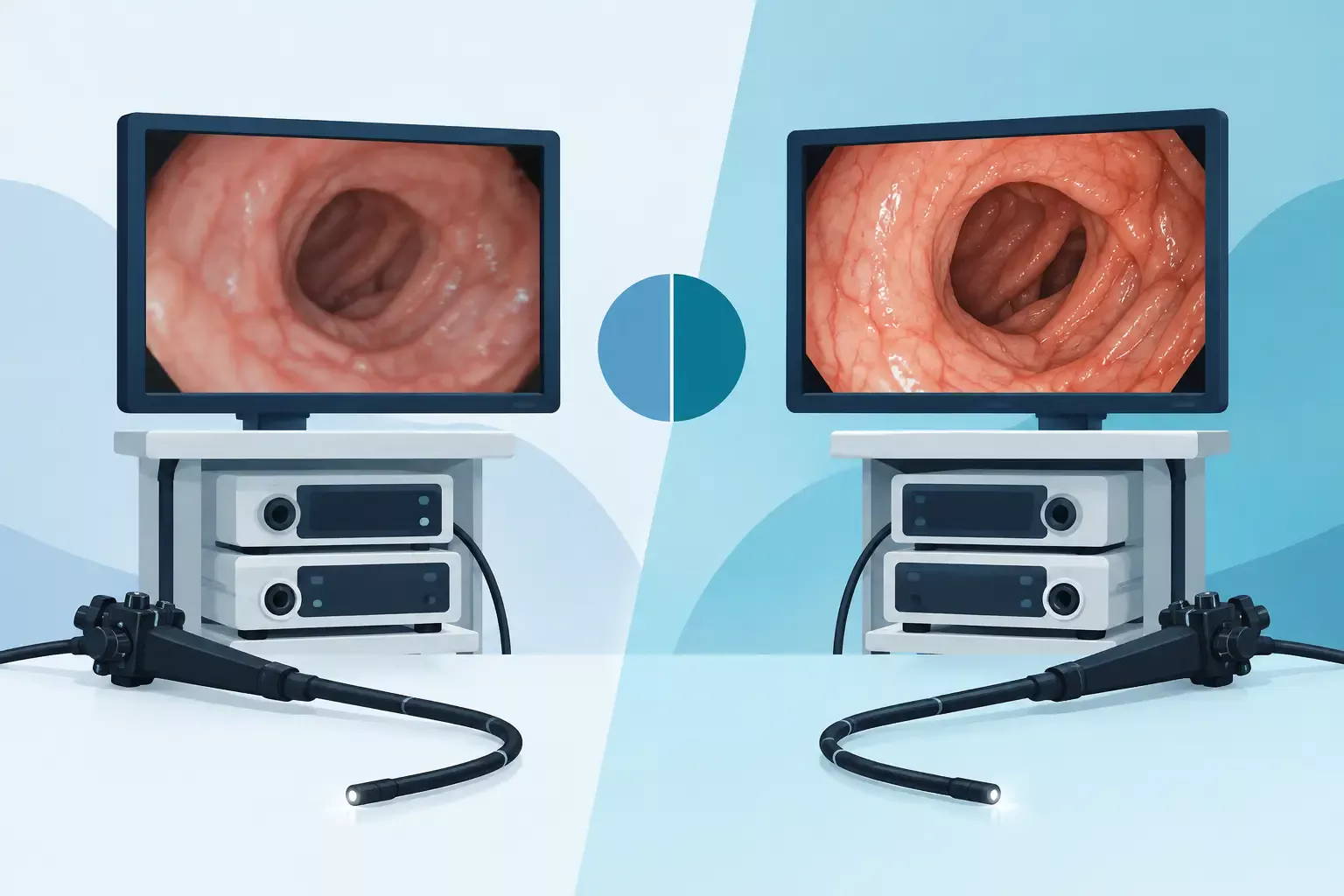
Olympus has developed the EVIS platform through three major generations, each with a different positioning in the market. Here is a direct comparison before going into detail on each.
EVIS X1
- 4K UHD resolution
- TXI — Texture & Color Enhancement
- RDI — Red Dichromatic Imaging
- NBI — Narrow Band Imaging
- AI-assisted lesion detection
- Highest diagnostic capability
EVIS EXERA III
- Full HD resolution
- NBI — Narrow Band Imaging
- Compatible with full 190-series scopes
- Strong installed base worldwide
- Proven in high-volume clinical settings
- Best cost-performance balance
EVIS EXERA II
- Reliable HD imaging
- Proven operational availability
- Lower acquisition cost
- Suitable for moderate-volume centers
- Strong secondary market availability
- Straightforward to operate and maintain
Full Feature Comparison Table
| Feature | EVIS X1 (CV-1500) | EVIS EXERA III (CV-190) | EVIS EXERA II (CV-170) |
|---|---|---|---|
| Generation | Latest | Current Reference | Consolidated |
| Resolution | 4K UHD | Full HD | HD |
| NBI | ✓ Yes | ✓ Yes | ✗ No |
| TXI (Texture & Color Enhancement) | ✓ Yes | ✗ No | ✗ No |
| RDI (Red Dichromatic Imaging) | ✓ Yes | ✗ No | ✗ No |
| AI-assisted lesion detection | ✓ Yes (supported) | ✗ No | ✗ No |
| Compatible gastroscopes | EVIS X1 line | GIF-H190, GIF-HQ190 | GIF-H170 |
| Compatible colonoscopes | EVIS X1 line | CF-H190, PCF-H190 | CF-H170 |
| Best suited for | Advanced diagnostic & therapeutic endoscopy | High-volume clinical endoscopy | Moderate-volume or budget-sensitive centers |
| Condition (Endoscopy Image) | Refurbished | Refurbished | Refurbished |
Deep Dive
EVIS X1 (CV-1500): The Most Advanced Olympus Platform
The EVIS X1 represents Olympus's most sophisticated endoscopy platform to date. Built around the CV-1500 video processor, it was designed for high-complexity diagnostic and therapeutic endoscopy environments where image quality and lesion characterization are clinical priorities.
Key technologies
- 4K UHD resolution: Four times the pixel density of HD, enabling magnification-level detail without a dedicated magnifying endoscope in many cases
- TXI — Texture and Color Enhancement Imaging: Enhances surface texture and color rendering of mucosal tissue, improving differentiation of subtle lesions
- RDI — Red Dichromatic Imaging: Improves visualization of bleeding sources and hemostasis by enhancing the contrast of red-spectrum tissue
- NBI — Narrow Band Imaging: Olympus's established optical contrast technology for vascular and mucosal pattern analysis
- AI support: The EVIS X1 platform includes AI-supported functionalities for endoscopy, as specified by Olympus. Availability and regulatory clearance vary by market and software version.
Deep Dive
EVIS EXERA III (CV-190): The Market-Reference Platform
If there is one refurbished Olympus endoscopy system that represents the broadest combination of performance, compatibility, and availability in the secondary market, it is the EVIS EXERA III built around the CV-190 processor.
Recognized globally as the standard platform for digestive endoscopy, the CV-190 has been adopted in clinical settings ranging from private outpatient centers to large academic hospitals. Its longevity in the market has created a deep ecosystem of compatible scopes and accessories.
Key features of the EVIS EXERA III
- Full HD imaging: Clear, detailed image output for both upper and lower GI endoscopy
- NBI — Narrow Band Imaging: Optical contrast technology for vascular and pit pattern analysis — standard on all CV-190 systems
- 190-series scope compatibility: Pairs with the GIF-H190 and GIF-HQ190 gastroscopes, and the CF-H190 and PCF-H190 colonoscopes
- GIF-HQ190 magnification support: When paired with the HQ190 gastroscope, the platform supports optical magnification for detailed early lesion analysis
- CLV-190 light source: Designed to work in tandem with the CV-190 for optimized and consistent illumination
EVIS EXERA III scope lineup
| Scope Model | Type | Working Channel | Key Feature | Application |
|---|---|---|---|---|
| GIF-H190 | Video Gastroscope | 2.8 mm | HD + NBI | Upper GI — esophagus, stomach, duodenum |
| GIF-HQ190 | Video Gastroscope | 2.8 mm | HD + NBI + optical magnification | Upper GI — enhanced early lesion detection |
| CF-H190 | Video Colonoscope | 3.2 mm | HD + NBI | Lower GI — full colonoscopy |
| PCF-H190 | Video Colonoscope | 3.2 mm | HD + NBI — slim design | Lower GI — pediatric / difficult colonoscopy |
Deep Dive
EVIS EXERA II (CV-170): Proven Performance at a Lower Investment
The EVIS EXERA II platform — centered on the CV-170 processor — represents an older Olympus generation that remains in active use across a large number of endoscopy facilities worldwide. It is a refurbished endoscopy equipment option that makes strong sense for specific scenarios.
When the EVIS EXERA II is the right call
- Clinics establishing a first endoscopy suite with a controlled budget
- Centers adding a second procedure room to existing infrastructure
- Facilities with lower weekly procedure volume where 4K or advanced optical enhancement is not a clinical priority
- Settings where team familiarity with the CV-170 platform already exists
The CV-170 system, combined with the GIF-H170 gastroscope and CF-H170 colonoscope, forms a complete, proven setup for diagnostic upper and lower GI endoscopy. Image quality is reliable HD. The platform is straightforward to operate and has a deep installed base globally.
Decision Guide
Which Refurbished Olympus System Is Right for Your Clinic?
The right platform depends on four factors: procedure complexity, weekly volume, budget, and whether imaging enhancement technologies (NBI, TXI, AI) are a clinical priority. Here is a practical decision guide.
For centers where advanced diagnostics are a priority
High-complexity endoscopy, academic hospitals, tertiary referral units, centers performing ESD, advanced resections, or AI-assisted protocols.
For most clinical endoscopy centers
Busy outpatient clinics, hospital endoscopy units, and multi-room GI suites that need proven HD imaging with NBI and a wide scope ecosystem.
For budget-sensitive or lower-volume settings
First procedure rooms, satellite clinics, or centers adding capacity without requiring advanced optical imaging enhancement.
Before You Buy
5 Things to Verify When Buying a Refurbished Olympus System
Confirm platform generation and processor model
EVIS X1, EXERA III, and EXERA II scopes are NOT cross-compatible. Confirm the exact processor model (CV-1500, CV-190, or CV-170) before selecting scopes.
Verify scope condition specifically
For any scope, ask about the condition of the insertion tube, bending section, and working channel — these are the highest-wear components on any endoscope.
Confirm the light source is included and compatible
The CLV-190 light source is designed to work with the CV-190 processor. Buying a processor without the matched light source creates immediate compatibility issues.
Ask about sourcing and documentation
A reputable supplier will provide documentation of the equipment's origin. Absence of sourcing transparency is a red flag regardless of how attractive the price appears.
Think about the complete system, not just the processor
Processor + matched light source + compatible scopes + monitor = a functional endoscopy setup. Plan the full system before purchasing any individual component.
Consider parts and accessory availability
The CV-190 platform has a deeper secondary market than the CV-1500. If long-term parts availability matters, factor this into your platform decision.
About Us
Endoscopy Image: Your Source for Refurbished Olympus Equipment
Endoscopy Image, operated by Are Medical LLC and headquartered in Key Biscayne, Miami, Florida, has been supplying hospitals, clinics, and surgical centers with medical equipment for over 30 years — including 15+ years of operation in the United States.
We carry refurbished Olympus systems across all three EVIS generations, as well as pre-owned video gastroscopes and colonoscopy equipment from the 190-series and 170-series scope lines.
All equipment we sell consists of pre-owned products acquired through lawful secondary market channels. We operate with full transparency about what we source and sell — worldwide delivery available.
Ready to Find the Right Olympus System for Your Facility?
Browse our full catalog of refurbished Olympus endoscopy systems and contact our team to discuss availability, platform compatibility, and pricing. Worldwide delivery available.
FAQ
Frequently Asked Questions
What does "refurbished Olympus endoscopy system" mean?
A refurbished Olympus endoscopy system is a pre-owned unit that has been acquired through lawful secondary market channels and made available for resale. At Endoscopy Image, we do not perform in-house repairs or refurbishment. All Olympus equipment we sell consists of pre-owned products sourced through verified secondary market channels — the term "refurbished" reflects their pre-owned status, not a rebuild or repair process.
What is the difference between the Olympus EVIS X1, EXERA III, and EXERA II?
The three platforms represent different generations of the Olympus EVIS endoscopy line. The EVIS X1 (CV-1500) is the most recent generation, featuring 4K UHD resolution, TXI, RDI, NBI, and AI-supported functionalities. The EVIS EXERA III (CV-190) is the widely adopted current-reference platform, offering Full HD imaging with NBI. The EVIS EXERA II (CV-170) is an older generation with reliable HD imaging, suited for centers with moderate volume needs or budget constraints. Scopes are not cross-compatible between platforms.
Are Olympus 190-series scopes compatible with the CV-170 processor?
No. The Olympus 190-series scopes (GIF-H190, GIF-HQ190, CF-H190, PCF-H190) are designed for the EVIS EXERA III platform (CV-190 processor). They are not compatible with the CV-170 processor, which is part of the EVIS EXERA II platform and pairs with the GIF-H170 gastroscope and CF-H170 colonoscope. Always confirm processor-scope compatibility before purchasing any component separately.
Which Olympus system is the best value for a mid-size endoscopy clinic?
For most mid-size clinical endoscopy centers, the EVIS EXERA III (CV-190) represents a strong balance of imaging performance, scope ecosystem breadth, and secondary market availability. It delivers Full HD imaging with NBI and supports a full lineup of 190-series gastroscopes and colonoscopes. The EVIS EXERA II (CV-170) is a viable alternative for centers with lower procedure volume or tighter budgets. The right choice depends on your specific clinical requirements, which we recommend discussing with your procurement team.
Does Endoscopy Image ship Olympus endoscopy equipment internationally?
Yes. Endoscopy Image supplies equipment to hospitals, clinics, surgical centers, and resellers worldwide. The company is headquartered in Key Biscayne, Miami, Florida, and ships to destinations globally. For specific availability, pricing, and shipping information, contact the team directly at endoscopyimage.com.