Pentax Video Processor Buying Guide: Imagina vs EPK-i5000 vs EPK-i7010
Pentax's video processor lineup spans three clear tiers — from a compact entry system to a processor built for teaching and advanced diagnostics. Here's how the Imagina, EPK-i5000, and OPTIVISTA EPK-i7010 actually differ, so you can match the right one to your procedure volume and clinical needs.
All three Pentax processors covered here share one important trait: i-SCAN, Pentax's proprietary image enhancement technology, is entirely software-based. It processes the video signal from the scope without changing the light source, which means it works across Pentax's compatible scope range without requiring a hardware upgrade. That's the foundation all three systems build on — the differences come down to light source technology, workflow features, and which additional enhancement modes are available.
Quick Comparison
| Processor | Tier | Light Source | Enhancement Modes | Compatible Scopes |
|---|---|---|---|---|
| Pentax Imagina | Entry | Integrated LED | i-SCAN (SE/CE/TE) | i10 series |
| Pentax EPK-i5000 | Mid | Xenon or LED | i-SCAN (SE/CE/TE) | 90i, 90K series |
| Pentax EPK-i7010 (OPTIVISTA) | Advanced | Xenon | i-SCAN (SE/CE/TE) + OE + TwinMode | i10 HD+ series |
1. Pentax Imagina — Entry-Level, Built for Routine Volume
Best For: Outpatient & Lower-Volume ClinicsThe Imagina pairs an EP-HD processor with an integrated LED light source, rated by Pentax at over 20,000 hours of use with no lamp replacement needed. It supports i-SCAN's three digital enhancement modes and connects via HDMI, LAN, and USB. It's compact and designed for straightforward day-to-day use — gastroscopies and colonoscopies in an outpatient setting — but it's not the right fit for complex therapeutic procedures like advanced EMR or ESD.
If your facility runs mostly routine diagnostic procedures and your priority is low maintenance overhead and a simple learning curve for staff, the Imagina is the most cost-effective entry point into Pentax's current-generation platform.
2. Pentax EPK-i5000 — The Mid-Tier Workhorse
Best For: General GI Practices Already on PentaxThe EPK-i5000 sits between the Imagina and the EPK-i7010. It runs on either a xenon or LED light source, uses CCD sensors, and is compatible with Pentax's 90i and 90K series scopes — a wider compatibility range if your facility has scopes from more than one generation. Like the Imagina, it relies on i-SCAN's three modes (Surface, Contrast, and Tone Enhancement) without any optical hardware addition.
This is generally the right processor for facilities already invested in Pentax's 90-series scope ecosystem and looking for solid, proven HD performance without moving up to the full OPTIVISTA feature set.
3. Pentax EPK-i7010 (OPTIVISTA) — Digital + Optical Enhancement
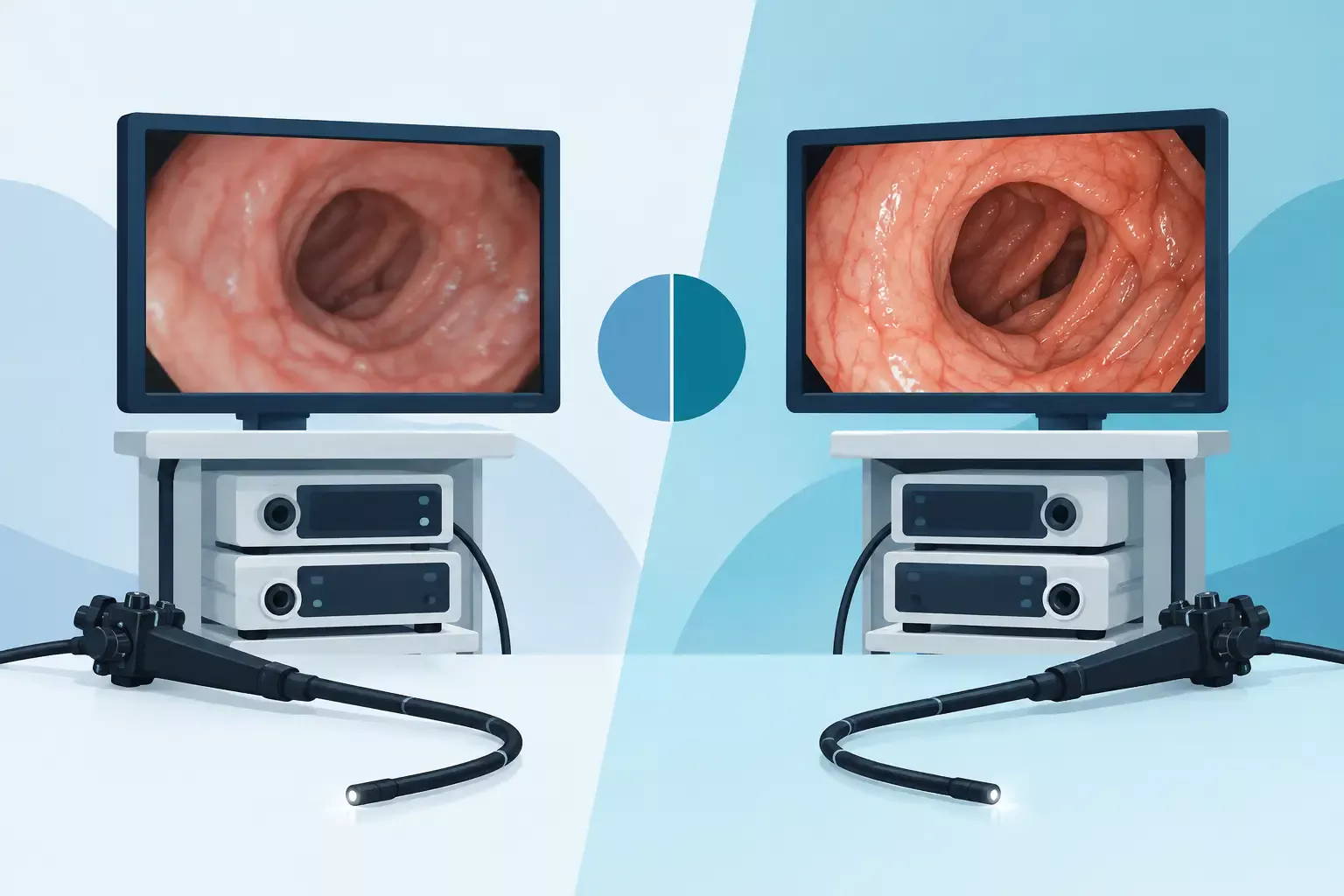
Best For: Advanced Diagnostics & Teaching EnvironmentsThe EPK-i7010, marketed by Pentax as OPTIVISTA, is the first Pentax processor to combine i-SCAN's digital enhancement with OE (Optical Enhancement) — an optical filter that narrows the light spectrum to improve contrast on blood vessels, glandular ducts, and mucosal structure, independent of digital processing. According to Pentax Medical's own product documentation, physicians can switch in real time between HD+ white light, i-SCAN's digital modes, and OE — and the system's TwinMode displays two enhancement modes side by side, which Pentax positions specifically as a teaching tool for interpreting image-enhanced endoscopy.
This processor makes the most sense for centers doing lesion characterization work, training residents or fellows on image-enhanced endoscopy, or handling higher procedure complexity where an extra layer of visual confirmation matters.
Decision Framework: Which Tier Fits Your Facility?
Routine, High-Volume Outpatient
Straightforward gastroscopies and colonoscopies, low maintenance overhead, budget-conscious purchase.
General GI Practice on Pentax Scopes
Already invested in 90i/90K series scopes, wants proven HD performance without the full OPTIVISTA feature set.
Advanced Diagnostics or Teaching
Lesion characterization, resident/fellow training, or procedures where optical + digital enhancement both add value.
Compatibility Snapshot
Why a Pre-Owned Pentax System Is a Practical Way In
All three processors covered here — Imagina, EPK-i5000, and EPK-i7010 — are realistic options on the pre-owned market, which matters because it lets a clinic match its budget to the tier it actually needs, rather than defaulting to whichever new processor a distributor pushes hardest. At endoscopyimage.com, every pre-owned Pentax system is functionally tested before listing. If you want more detail on a specific model, our complete guides to the Pentax Imagina and the Pentax EPK-i5000 go deeper into each system.
Browse our full endoscopy equipment catalog, or go straight to video gastroscopes and colonoscopy equipment if you already know which component you need. If your upgrade also touches your surgical stack, our video surgery equipment catalog covers that side of the department too.
Frequently Asked Questions
What's the main difference between i-SCAN and OE?
i-SCAN is a digital, software-based enhancement that processes the video signal without changing the light source, so it works across Pentax's compatible scope range without a hardware upgrade. OE (Optical Enhancement), available only on the EPK-i7010, is an optical filter that changes the light itself before capture. The EPK-i7010 is the only processor in this lineup that offers both.
Can I use my existing Pentax scopes with any of these processors?
It depends on the scope series. The Imagina pairs with i10 series scopes, the EPK-i5000 with 90i and 90K series, and the EPK-i7010 with the i10 HD+ series. Confirm your specific scope model's compatibility before purchasing a processor separately from your scope inventory.
Is the EPK-i7010 worth it if I don't do advanced therapeutic procedures?
Not necessarily. TwinMode and OE are most valuable for lesion characterization, teaching, and higher-complexity diagnostic work. For routine screening and general GI practice, the Imagina or EPK-i5000 typically deliver the imaging quality needed without the added cost of the OPTIVISTA feature set.
Is pre-owned Pentax equipment a reliable option?
Pre-owned Pentax equipment can be a reliable option when it has been functionally tested and comes with documentation from the seller. Endoscopy Image labels all Pentax equipment as pre-owned and tests functionality before listing.
Not Sure Which Pentax Processor Fits Your Clinic?
Tell us your procedure mix and current scope inventory — we'll help you match the right tier, whether that's the Imagina, the EPK-i5000, or the EPK-i7010.
Get a Personalized Quote