CV-190 or EVIS X1: when does the upgrade make sense?
A side-by-side look at the Olympus EVIS EXERA III (CV-190) and EVIS X1 (CV-1500) platforms, built only on manufacturer and FDA documentation, for clinics and hospitals choosing a refurbished Olympus system.
Should you choose the Olympus CV-190 or the EVIS X1?
Choose the EVIS X1 if your team will use its newer imaging. The CV-1500 adds TXI, RDI and BAI-MAC to white light and NBI, integrates an LED light source and, per its FDA clearance, works with 190 and 1100 series scopes. If white light and NBI cover your routine, the CV-190 remains a capable platform.
- CV-190: WLI + NBI
- CV-1500: + TXI, RDI, BAI-MAC
- LED light built in
- 190 scopes supported
- The Olympus CV-190 is the video system center of the EVIS EXERA III platform, introduced by Olympus in 2012 and paired with the separate CLV-190 xenon light source.
- The Olympus CV-1500 is the video system center of the EVIS X1 platform, launched in 2020 and cleared by the FDA in April 2023, with the light source integrated into the same unit.
- According to its FDA 510(k) clearance, the CV-1500 is compatible with scopes within the EVIS 190 and 1100 families.
- The EVIS X1 adds TXI, RDI and BAI-MAC observation modes. Olympus describes them as adjunctive tools that supplement white light imaging and do not replace histopathology.
Olympus introduced the EVIS EXERA III platform, built around the CV-190 video system center.
CV-1500 with integrated LED light, compared with a 10.7 kg CV-190 plus a 19 kg CLV-190 xenon light source.
Compatible with the CV-1500, per its FDA 510(k).
NBI, TXI, RDI and BAI-MAC on the CV-1500.
Launched first in Europe, the Middle East and Africa, Australia, India and Hong Kong. U.S. market launch followed in October 2023.
Read the story behind Endoscopy Image.
What is the difference between the Olympus CV-190 and the EVIS X1?
The Olympus CV-190 and the Olympus CV-1500 are video system centers from two consecutive Olympus generations: the CV-190 runs the EVIS EXERA III platform, and the CV-1500 runs the EVIS X1 platform.
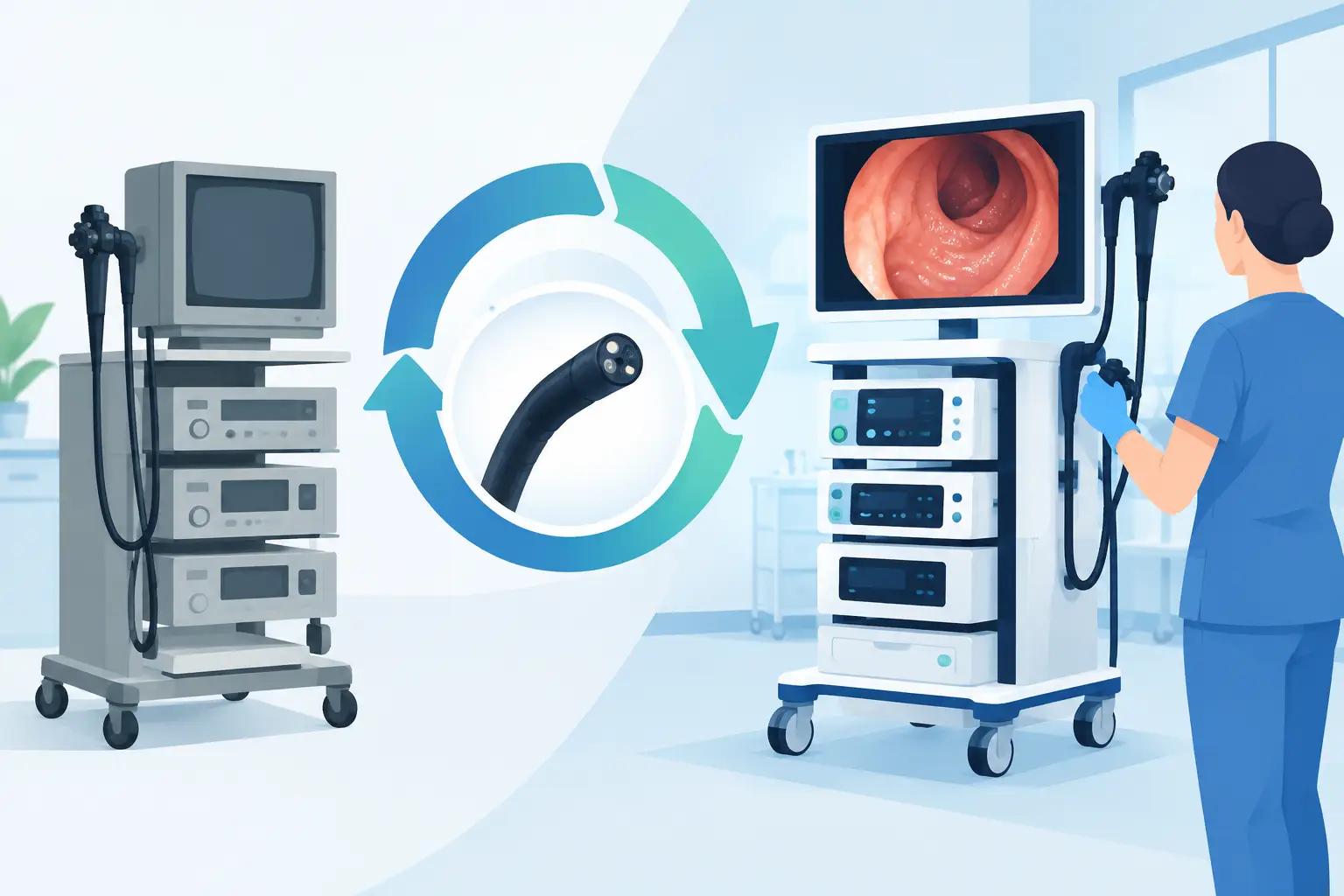
The most visible difference is the tower layout. An EVIS EXERA III tower uses the CV-190 together with a separate CLV-190 xenon light source. In an EVIS X1 tower, the CV-1500 processes the image and provides LED illumination in a single unit. Olympus also used the CV-190 and CLV-190 as the predicate devices when it submitted the CV-1500 to the FDA, so the official comparison below comes from that filing.
| Item | EVIS EXERA III · CV-190 | EVIS X1 · CV-1500 |
|---|---|---|
| Light source | Separate CLV-190, 300 W xenon short-arc lamp | Integrated LED |
| Observation modes | White light, NBI | White light, NBI, TXI, RDI, BAI-MAC |
| Scope generation | Designed for EVIS EXERA III 190 series scopes | Compatible with EVIS 190 and 1100 series scopes |
| Touch panel | Not provided | Provided |
| White balance | Automatic, using the white balance switch | 190 series: same as CV-190. 1100 series: automatic, no switch needed |
| Network port | 100BASE-TX | 1000BASE-T |
| Digital video outputs | SDI ×2, DVI ×1 | SDI ×2 |
| Emergency lamp | Halogen lamp in the CLV-190 | Not provided |
| Weight | 10.7 kg (CV-190) + 19 kg (CLV-190) | 19.4 kg |
| Stored user settings | Up to 20 users | Up to 20 users |
What "refurbished" means for Olympus systems at Endoscopy Image. Olympus systems offered by Endoscopy Image are refurbished units of pre-owned equipment acquired through lawful secondary market channels. They are not new, and they are not refurbished, certified or sold by Olympus.
Browse the current refurbished Olympus endoscopy systems or the full catalog of endoscopy equipment.
What does the EVIS X1 add over the CV-190?
The EVIS X1 keeps NBI and white light from the previous generation and adds three observation modes, an integrated light source and a new scope generation. Each point below is based on Olympus' public product information and the FDA 510(k) summary.
-
01Imaging
TXI: Texture and Color Enhancement Imaging
The FDA summary describes TXI as a mode that emphasizes tonal changes, patterns and image outlines while correcting the brightness of dark areas. Olympus states it is designed to increase the visibility of lesions and polyps by enhancing color and texture during screening.
Why it mattersAn additional view of the mucosa during routine screening, alongside white light. -
02Imaging
RDI: Red Dichromatic Imaging
RDI uses red dichromatic narrow band light and green illumination to enhance the visibility of bleeding points. Olympus states it is designed to enhance the visibility of deep blood vessels and bleeding points.
Why it mattersA dedicated view for vessels and bleeding sources that the CV-190 does not offer. -
03Imaging
BAI-MAC: brightness correction
BAI-MAC corrects the brightness of dark areas of the endoscopic image while maintaining the brightness of lighter areas. Olympus describes the goal as increasing the total distance view.
Why it mattersDarker, distant areas of the lumen become easier to see without overexposing the foreground. -
04Hardware
LED light integrated into the processor
The CV-1500 provides LED illumination itself, so the tower no longer needs a separate xenon light source. Olympus describes it as a unified platform with five-LED spectrum technology, and the FDA summary lists the CV-1500 at 19.4 kg.
Why it mattersOne unit instead of two, which simplifies the tower layout. -
05Workflow
Touch panel and faster connection
According to Olympus, the touch panel on the CV-1500 lets users initiate procedures and settings and control image data from one device. With 1100 series scopes, white balance is adjusted automatically without pressing the white balance switch.
Why it mattersFewer setup steps between cases. -
06Scopes
Access to 1100 and EDOF scopes
The GIF-1100 gastroscope and CF-HQ1100DL/I colonoscope were cleared with the CV-1500, and Olympus states their ErgoGrip control section is 10% lighter than its previous generation. In May 2025, Olympus announced FDA clearance of its EZ1500 series with Extended Depth of Field (EDOF), as part of the EVIS X1 system.
Why it mattersA path to newer scope generations when your unit is ready.
NBI, TXI, RDI and BAI-MAC are adjunctive tools that supplement Olympus white light imaging. According to the FDA 510(k) summary, they are not intended to replace histopathological sampling as a means of diagnosis.
What does the Olympus CV-190 still do well?
The CV-190 is the processor of EVIS EXERA III, the Olympus generation launched in 2012. Its FDA filing lists noise reduction, Pre-Freeze and brighter, higher-contrast NBI among its features, and Olympus made HD standard for all routine scopes in this generation.
Brighter NBI
Olympus states that NBI with EVIS EXERA III gives twice the viewable distance of the previous generation and is significantly brighter.
Dual Focus
On HQ190 scopes such as the GIF-HQ190 and CF-HQ190L/I, physicians can switch from normal to near focus at the press of a button.
Pre-Freeze
When the physician captures a frame, Pre-Freeze selects the clearest still image from frames held in internal memory.
For units that rely on white light and NBI, a complete CV-190 tower with matching video gastroscopes and colonoscopy equipment from the 190 series remains a practical configuration. For ERCP work, browse our duodenoscope catalog as well.
Can your 190 series scopes work with the EVIS X1?
Yes, according to the FDA 510(k) clearance for the EVIS X1 CV-1500, which states that it is compatible with scopes within the EVIS 190 and 1100 families.
When Olympus launched EVIS X1 in 2020, it also described a cross-compatibility between EVIS EXERA III and EVIS LUCERA ELITE, two systems that had been separate until then. In practice, this means a unit that already owns 190 series scopes can plan a move to the CV-1500 without replacing every scope at once.
Two points need checking for each scope you own. First, confirm which observation modes are available for that exact model on the CV-1500, using the manufacturer's information. Second, note that white balance with 190 series scopes still uses the white balance switch, while 1100 series scopes adjust automatically.
- 2006
EVIS EXERA II. Olympus launches EVIS EXERA II, featuring Narrow Band Imaging.
- 2012
EVIS EXERA III. The CV-190 platform arrives with brighter NBI, Dual Focus on HQ scopes and Pre-Freeze.
- 2020
EVIS X1. Launched in Europe, the Middle East and Africa, Australia, India and Hong Kong, with TXI, RDI and EDOF announced.
- 2023
U.S. clearance and launch. FDA clears the CV-1500 with the GIF-1100 and CF-HQ1100DL/I in April. Olympus announces the U.S. market launch in October.
- 2025
EDOF scopes. Olympus announces FDA clearance of the GIF-EZ1500 and CF-EZ1500DL/I as part of the EVIS X1 system.
Which Olympus platform fits your unit?
The right choice depends less on which system is newer and more on which imaging your physicians will use every day.
CV-190 fits best
- Units whose routine relies on white light and NBI
- Facilities already working with 190 series scopes and a CLV-190
- A second room that should match an existing EXERA III tower
EVIS X1 fits best
- Units that plan to use TXI, RDI or BAI-MAC
- Facilities that want a path to 1100 or EDOF scopes
- New rooms that prefer one processor with built-in light
Evaluate both
- Units with 190 series scopes planning a gradual upgrade
- Teams that have not yet worked with the new modes
- Projects where the full tower budget is still open
If you are also comparing other brands, see how a pre-owned Pentax EPK-i7010 compares as an alternative, or read our Pentax video processor buying guide. For a deeper look at the newer platform, read whether a refurbished EVIS X1 is worth it.
How do you buy a refurbished Olympus tower with confidence?
A good purchase starts with confirming the configuration before anything ships. Use these four steps for either platform.
- List your equipmentWrite down the exact models of your processors, light sources, scopes and monitors, and the procedures you perform most.
- Confirm compatibilityCheck each scope model, and the observation modes it supports, against the manufacturer's compatibility information.
- Ask what is includedRequest the configuration of the specific unit: processor, light source, scopes and cables.
- Plan shippingEndoscopy Image ships worldwide from Miami and can assist with documentation for import compliance.
Before deciding, review our checklist for evaluating a used endoscope and our colonoscope buying guide. If you need equipment for a limited period, see the options for endoscopy equipment rental.
How can you get the most from either Olympus platform?
Confirm scope compatibility
Check each exact scope model against the manufacturer's compatibility information before purchase, especially if you plan to mix 190 and 1100 series scopes.
Check your reprocessing setup
Confirm that your reprocessor and cleaning protocols are validated for the scope models you will use. Learn how reprocessing affects repair frequency.
Train the team on new modes
TXI, RDI and BAI-MAC add value only when physicians know when to use them. Plan training time if you move to the EVIS X1.
Plan image archiving
Define where captured images and video will be stored. Our guide to DICOM in endoscopy covers the basics, and every scope should pass a leak test before use.
If your facility also performs laparoscopic procedures, explore our video surgery equipment from Stryker and Karl Storz, or our wider range of pre-owned endoscopy equipment.
Compare an Olympus CV-190 and EVIS X1 tower for your unit.
Talk to our specialists about the refurbished Olympus systems available and the configuration that fits your facility.
Frequently asked questions
Quick answers about the Olympus CV-190, the EVIS X1 and buying either one refurbished.
What is the difference between the Olympus CV-190 and the EVIS X1?
The CV-190 is the video system center of the Olympus EVIS EXERA III platform and works with a separate CLV-190 xenon light source. The EVIS X1 uses the CV-1500, which integrates an LED light source and adds TXI, RDI and BAI-MAC to white light and NBI.
Can I use my Olympus 190 series scopes with the EVIS X1?
According to its FDA 510(k) clearance, the EVIS X1 CV-1500 is compatible with scopes within the EVIS 190 and 1100 families. Confirm each exact scope model, and the observation modes it supports, against the manufacturer's information before purchase.
Does the EVIS X1 need a separate light source?
No. The CV-1500 video system center provides LED illumination itself, while the CV-190 is used with a separate CLV-190 xenon light source.
What are TXI, RDI and BAI-MAC?
They are observation modes of the EVIS X1. TXI emphasizes tonal changes, patterns and outlines, RDI enhances the visibility of bleeding points, and BAI-MAC brightens dark areas while keeping bright areas stable. They supplement white light imaging and do not replace histopathology.
Is the Olympus CV-190 still a good choice?
For units whose routine relies on white light and NBI, the CV-190 remains a capable platform. Olympus states that NBI with EVIS EXERA III gives twice the viewable distance of the previous generation, and HQ190 scopes add Dual Focus.
Are refurbished Olympus systems from Endoscopy Image sold by Olympus?
No. Endoscopy Image is an independent supplier. Its Olympus systems are refurbished units of pre-owned equipment acquired through lawful secondary market channels, and they are not new, nor refurbished, certified or sold by Olympus.
- Olympus Medical Systems, news release on the launch of EVIS EXERA III (March 2012)
- U.S. FDA 510(k) summary K112680, EVIS EXERA III Video System, CV-190 (2012)
- Olympus Corporation, announcement of the EVIS X1 launch (April 2020)
- U.S. FDA 510(k) summary K222584, EVIS X1 CV-1500, GIF-1100 and CF-HQ1100DL/I (April 2023)
- Olympus Corporation of the Americas, U.S. market launch of EVIS X1 (October 2023)
- Olympus Corporation of the Americas, FDA clearance of EZ1500 series EDOF endoscopes (May 2025)
- Olympus America, CV-1500 product brochure and NBI technology information
- Olympus Europe, company milestones
Technical descriptions are based on publicly available manufacturer and FDA documentation.
Olympus, EVIS, EVIS X1, EVIS EXERA, EVIS LUCERA, NBI, Narrow Band Imaging, TXI, RDI, BAI-MAC, EDOF and ErgoGrip are trademarks or registered trademarks of Olympus Corporation or its affiliates. Endoscopy Image (Are Medical LLC) is an independent supplier of pre-owned and refurbished medical equipment and is not affiliated with, authorized by, sponsored by or endorsed by Olympus. Product names are used for identification purposes only. Specifications, configuration and compatibility must be confirmed for each unit before purchase.